
Ask the AI Course Tutor
Have a question about this course? Chat with our AI Tutor below — it can explain concepts, help you review, and estimate your current knowledge level.
🔒 The AI Tutor is available to enrolled students.
Purchase this course to unlock personalized AI tutoring, concept explanations, and quiz prep.
Enroll to Unlock the AI Tutor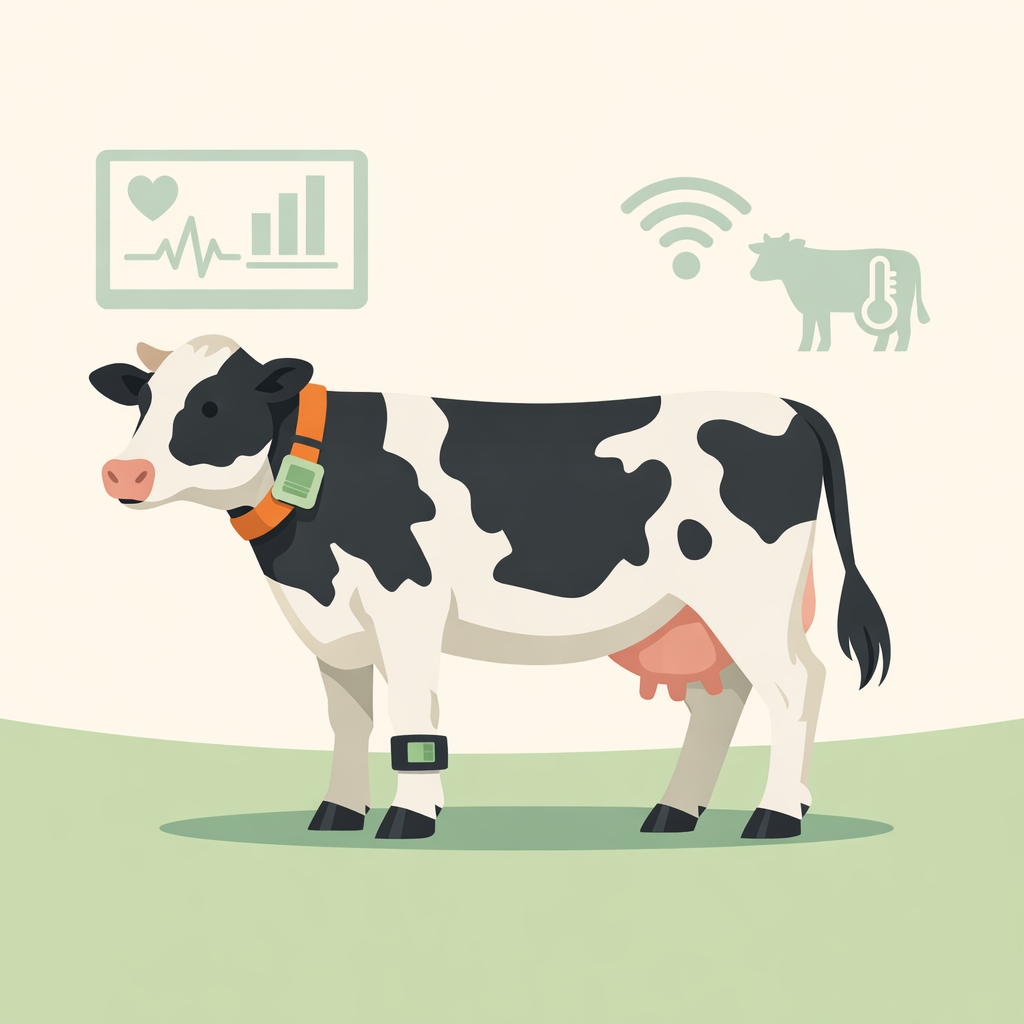
Course Overview
The livestock industry is undergoing a quiet revolution driven by sensor technology, data analytics, and automation. This course equips students with practical skills in precision livestock farming (PLF) — using technology to monitor individual animal health, optimize nutrition, manage reproduction, and improve welfare while reducing labor costs and environmental impact.
Prerequisites
Basic understanding of livestock production helpful. Duration: 8 weeks self-paced.
Module 1: Introduction to Precision Livestock Farming
Learning Objectives
Define precision livestock farming and its economic case; identify the key sensing technologies used in PLF; explain how real-time monitoring transforms herd management.
Core Content
Precision Livestock Farming (PLF) uses continuous, automated monitoring of individual animals to detect health problems early, optimize feeding, improve reproduction rates, and reduce labor. The economic case is compelling: detecting mastitis in dairy cattle 24 hours earlier than traditional methods saves an average of $285 per case; early lameness detection prevents up to $300 in production losses per cow per event.
Core PLF sensing technologies: Accelerometers and activity monitors (ear tags, leg bands, collars — Afimilk, Lely, SCR/Allflex) detect estrus, lameness, and general health changes through changes in movement patterns. Rumination monitors (ear tag microphones, collar sensors) — reduced rumination is an early indicator of health issues and feed inefficiency. Body temperature sensors (bolus thermometers, ear thermometers) — fever detection 12-24 hours before clinical signs. Milk conductivity and production monitoring (inline sensors in milking systems) — mastitis detection. Automated weight scales — feed-to-gain ratio calculation, drafting systems. Feed intake monitoring systems (individual feed stations with RFID — Nedap, Lely Vector).
Theory into Practice
1. Access the EU PLF Technology Platform resources at plf.eu for the latest research summaries. 2. Watch “Inside a Smart Dairy Farm” on YouTube (DeLaval, Lely, GEA official channels). 3. Read the free open-access paper “Precision Livestock Farming: Making Sense of Data” (search Google Scholar — multiple open-access versions available). 4. Access the Allflex Livestock Intelligence website (allflex.global) and explore the SenseHub monitoring system specifications.
Case Study: Netherlands Robotic Dairy Farming
The Netherlands has the highest density of automated milking systems (AMS/robotic milkers) in the world. A typical 200-cow Dutch dairy farm uses a DeLaval VMS V300 automatic milking robot: cows choose when to be milked, sensors analyze milk quality and quantity per quarter, health alerts are sent to the farmer’s phone, and feeding is automatically adjusted based on individual production data. Labor requirement: 60% lower than conventional milking parlors. Milk yield: typically 5-8% higher as cows are milked on their own schedule (2.8x/day average vs. 2x/day conventional).
Module 2: Reproductive Management & Estrus Detection Technology
Learning Objectives
Explain reproductive physiology and its relationship to farm profitability; use activity-based estrus detection technology; design a precision reproductive management program.
Core Content
Reproductive efficiency is the single largest driver of dairy profitability. Every day open (days not pregnant) after the voluntary waiting period costs $3-6 in lost milk and reproductive expenses. Activity-based estrus detection achieves 90-95% detection rates vs. 50-60% for visual observation — the critical improvement that makes technology-based reproduction programs profitable. Systems: SCR Heatime (neck tag with rumination monitoring), Afimilk AfiFarm, Nedap CowControl, MooMonitor, and GPS-based systems for extensive grazing operations (Moo-niverse, Moonsyst).
Automated pregnancy confirmation: Inline milk progesterone testing (DeLaval Progesterone, AfiLab) provides results within 45 minutes of morning milking — eliminating vet visits for routine pregnancy checks in well-managed herds.
Scenario Exercise
A 350-cow dairy farm currently uses visual estrus detection with a 58% detection rate and 65% conception rate (first service). Calculate: (1) Current calving interval; (2) Days open cost per cow; (3) Impact on 350-cow herd profitability if detection rate improves to 92% and days open reduces by 18 days using SCR Heatime Pro system. Use the University of Wisconsin’s Dairy Reproductive Economics calculator (dairymgt.info) to verify your calculations.
Module 3: Animal Health Monitoring & Disease Early Detection
Core Content
Disease early detection ROI: bovine respiratory disease (BRD) in feedlot cattle — early detection (day 1-2) reduces treatment cost from $80 to $25 and prevents lung damage. BRD is responsible for 70-80% of illness and 40-50% of feedlot deaths. Fever detection systems: SubQ thermometer bolus (continuous temperature monitoring), Moovement ear tags, Optibrand retinal scanning (for BRD risk assessment). Lameness detection: force-plate walkways (Veterinary Instrumentation DairyClaw), camera-based locomotion scoring (Cainthus AI cameras, StepMetrix), and GPS step counting (Moocall). Early lameness detection saves $100-300/cow in treatment, production loss, and culling.
Module 4: Precision Feeding & Nutrition Management
Core Content
Precision feeding systems: Individual concentrate feeders (Lely Cosmix, DeLaval InHerd) dispense exact rations based on production stage, body condition, and health status. TMR (Total Mixed Ration) management: Livestock Nutrition Center DAISY system, ForFarmers nutrition optimization software. Individual feeding reduces concentrate overfeeding by 15-20% (saving $100-150/cow/year) while maintaining or improving milk production. Body Condition Scoring (BCS) cameras: automated BCS assessment using 3D cameras (DeLaval BCS, Quantified Ag) — replaces time-consuming manual scoring with objective, real-time data for 100% of the herd.
Module 5: Environmental Impact, Welfare & Future Technologies
Core Content
PLF contribution to sustainability: Precision nutrition reduces feed waste and lowers methane emissions per unit of product. Real-time health monitoring reduces antibiotic use by 15-30% (early treatment of mild cases vs. delayed treatment of advanced cases). Automated welfare monitoring systems (continuous camera AI for abnormal behavior detection) improve compliance with increasingly stringent welfare standards. Future trends: methane breath sensors (Zelp halter, Arkeabio vaccine), continuous rumen pH boluses, saliva composition sensors, microbiome-based feed optimization, and computer vision body weight estimation.
Final Project
Design a complete Precision Livestock Farming implementation plan for a 500-cow commercial dairy farm transitioning from conventional to precision management. Deliverables: (1) Technology audit of current systems, (2) Priority technology selection (ranked by ROI), (3) Estrus detection and reproductive protocol redesign, (4) Health monitoring alert protocol and response procedures, (5) Staff training plan, (6) Data management and privacy protocol, (7) Full 5-year financial model with NPV and payback period calculation.
Curriculum
- 5 Sections
- 6 Lessons
- 10 Weeks
- Module 1: Introduction to Precision Livestock Farming3
- Module 2: Reproductive Management & Estrus Detection Technology1
- Module 3: Animal Health Monitoring & Disease Early Detection1
- Module 4: Precision Feeding & Nutrition Management1
- Module 5: Environmental Impact, Welfare & Future Technologies1
