
Self-paced practical course · 6 lessons · estimated 4–6 hours
Learn to build and operate a greenhouse integrated pest management (IPM) routine. You will practice prevention, systematic scouting, evidence-based identification, action planning, biological-control awareness, recordkeeping, and follow-up. This course teaches a decision process; it does not authorize pesticide use or replace local crop-protection advice.
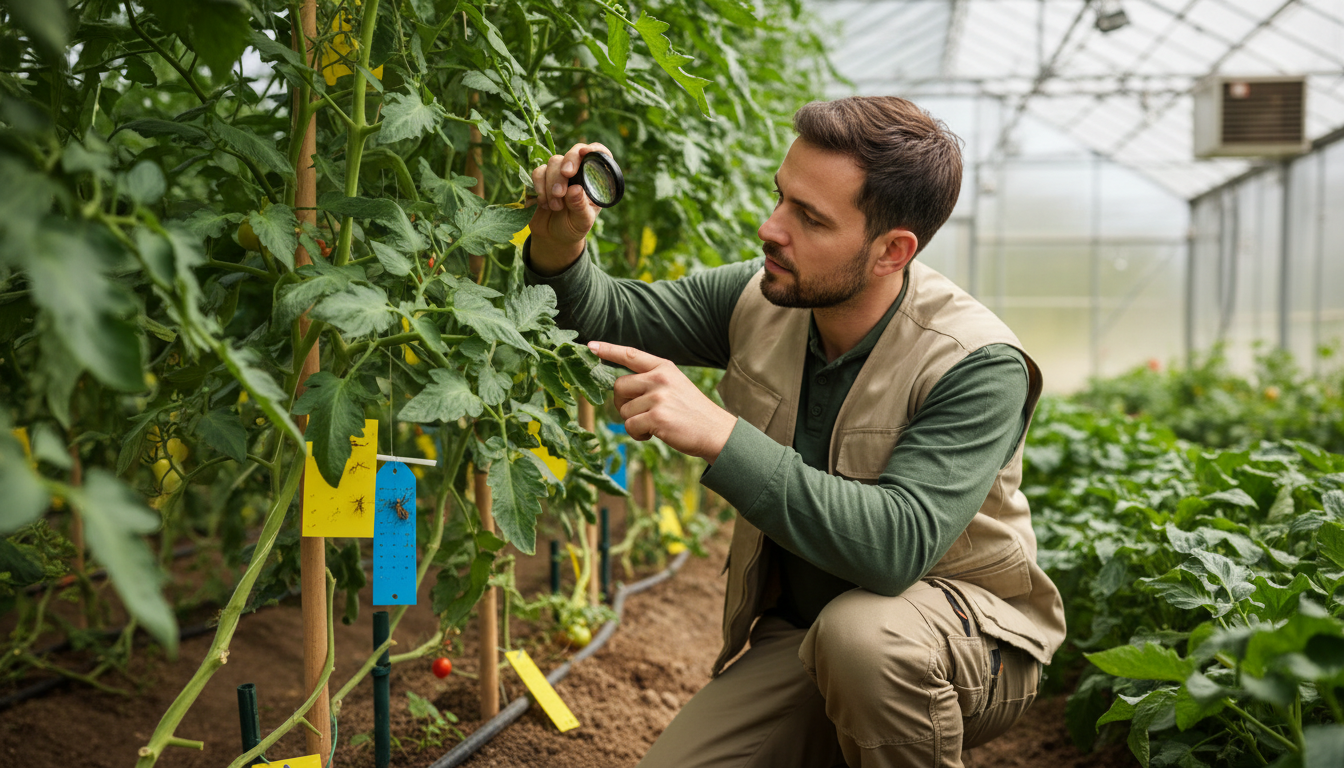
Course outcomes
- Prepare a greenhouse scouting route and use a consistent sampling method.
- Record pest, beneficial insect, crop stage, location, and symptom observations without confusing observations with diagnoses.
- Use a reliable identification and escalation pathway when evidence is uncertain.
- Compare prevention, cultural, physical, and biological-control options within site protocols.
- Make a documented, human-reviewed action plan and check whether it worked.
Materials and safety
For practice, use a clipboard or spreadsheet, greenhouse map, hand lens, clean disposable gloves if required by site rules, sticky-card log, and phone or camera used according to privacy policy. Follow site hygiene and biosecurity procedures. Never handle unknown organisms, release biological control agents, or apply a pesticide without authorization, training, and the applicable label and local rules.
Section 1 · Lesson 1: Prevent problems before they spread
Purpose: reduce pest entry and remove conditions that help pests establish. Procedure: 1) Walk the perimeter and note doors, vents, screens, incoming plant material, and shared tools. 2) Check the site’s visitor, worker, and plant-entry hygiene rules. 3) Inspect incoming plants in a designated area and keep their lot and supplier records. 4) Review weeds, plant debris, standing water, and crop residues using the facility sanitation schedule. 5) Record any screen damage, door gaps, or sanitation issue as a work order with location, date, evidence, and owner. 6) Recheck the issue on the assigned date. Practice: mark five possible pest-entry or harboring points on a simple greenhouse map and rank them by likelihood and consequence.
Lesson check: Why isolate incoming plant material? What evidence belongs in a maintenance request? Sample response: isolation permits observation and traceability before plants enter production; record supplier/lot, date, location, observed concern, photo if allowed, and responsible reviewer.
Section 2 · Lesson 2: Build a repeatable scouting route
Purpose: collect comparable observations over time. Procedure: 1) Draw blocks, aisles, entrances, vents, and crop zones on the map. 2) Choose a fixed route that covers edges and interior areas; avoid choosing only visibly damaged plants. 3) Use the same sample count and plant parts for each visit, following the crop or facility protocol. 4) At every stop, inspect the same canopy positions and note pest signs, beneficial insects, crop stage, and symptom severity. 5) Place and number monitoring cards only where permitted; record installation date and exact location. 6) Record zero findings as “not observed” rather than leaving the field blank. Practice: complete a five-stop sample log for a fictional 500-square-meter greenhouse.
| Stop | Zone / plant count | Observed signs | Beneficials | Follow-up |
|---|---|---|---|---|
| A | North edge / 5 plants | Example: stippling on lower leaves | Not observed | Recheck marked plants |
| B–E | Complete from route | Record what is seen | Record separately | Assign owner and date |
Section 3 · Lesson 3: Separate symptoms from identification
Purpose: avoid acting on a guess. Procedure: 1) Describe the symptom plainly: color, shape, plant part, and extent. 2) Note distribution: one plant, row, edge, hot spot, or widespread pattern. 3) Check for visible organisms, webbing, frass, eggs, or feeding marks without damaging the crop. 4) Photograph an affected and a healthy comparison with a scale reference, if site policy allows. 5) Compare with approved diagnostic references or send a sample through the facility’s qualified diagnostic pathway. 6) Record the identification source and confidence. If uncertain, label it “unconfirmed” and escalate. Practice: classify each item in a case note as observation, hypothesis, or confirmed identification.
Illustration guide: imagine a three-panel comparison: (A) the whole affected plant and its location, (B) close-up symptom with scale, (C) healthy comparison from the same crop block. Captions should state date, crop stage, and sampling point; do not label a pest as confirmed until evidence supports it.
Section 4 · Lesson 4: Choose a response within the IPM plan
Purpose: select a proportionate response from approved options. Procedure: 1) Review trend data, crop stage, distribution, and the facility’s action thresholds. 2) Confirm whether the identification is reliable enough to act. 3) Consider prevention and cultural measures first: sanitation, screening repair, removal of heavily affected material under protocol, irrigation or ventilation corrections when supported by evidence, and worker movement controls. 4) For biological controls, confirm target organism, compatibility, temperature/humidity needs, supplier guidance, release location, and monitoring method with the responsible specialist. 5) Compare expected benefit, crop risk, labor, cost, and non-target effects. 6) Obtain the required approval before implementation and record who approved the action. Chemical controls are outside this course’s operating instructions; use only under competent authorization and label directions.
Section 5 · Lesson 5: Keep records that support decisions
Purpose: make each response traceable and learn from results. Use one record per scouting visit: date/time, scout, crop/block, crop stage, route and sample count, observations, monitoring-card counts, identification source/confidence, action threshold/reference, chosen action, approver, owner, and review date. After an action, repeat the same sampling method at the planned interval and compare results with the baseline. Record weather or operating changes that may affect interpretation. If the trend worsens or uncertainty remains, pause further action and escalate through the site protocol.
Section 6 · Lesson 6: Applied greenhouse IPM plan
Capstone: prepare a two-week IPM plan for a fictional greenhouse block where early signs of whitefly are observed on a few lower leaves near an entry door. Submit: (1) a route map with five sampling stops, (2) a baseline log, (3) an identification and confidence note, (4) two prevention or cultural actions, (5) a biological-control consultation checklist, (6) an approval and responsibility table, and (7) a follow-up date and success measure. Do not prescribe an unapproved treatment.
Timed self-assessment · 12 minutes
- A scout sees leaf stippling. Is this a symptom description or a confirmed pest identification?
- Why use the same route and sample count at each visit?
- What does “not observed” communicate that a blank field does not?
- Name two records needed to trace incoming plants.
- Which evidence helps distinguish a localized entry-point problem from a greenhouse-wide trend?
- What should happen when identification confidence is low?
- Why record beneficial insects separately from pest counts?
- Who authorizes a biological-control release under a facility plan?
- What should be compared during follow-up?
- When should a scout stop and escalate rather than take action?
Answer guide and scoring
Answers: 1) Symptom description. 2) Consistency makes trends more comparable. 3) It documents that the check occurred and the condition was not seen in that sample. 4) Supplier/lot and arrival date, plus inspection/isolation record. 5) Distribution by location, repeat counts, route map, and entry/screen inspection. 6) Mark unconfirmed and use the approved diagnostic/escalation pathway. 7) Beneficials affect interpretation and compatible response options. 8) The designated qualified approver under the site plan. 9) Same-method pest/beneficial counts and crop condition versus baseline. 10) Uncertain identity, unexpected spread, safety concern, or action outside authorization. Score 1 point each; suggested completion threshold 8/10. Review incorrect answers and revise the capstone plan.
Capstone rubric
| Criterion | Points | Meets standard when… |
|---|---|---|
| Scouting map and sampling consistency | 25 | Route, sample locations, and count are clear and repeatable. |
| Evidence and identification | 25 | Observations are separated from hypotheses and uncertainty is recorded. |
| Response and safety | 25 | Actions fit the site plan, include approval, and avoid unsupported treatment advice. |
| Records and follow-up | 25 | Owners, dates, baseline, and success measures are documented. |
Completion: score at least 70% on the self-assessment and 3 out of 4 on every capstone rubric criterion. Revise any section below standard. Keep the completed plan as evidence of learning.
