
Introduction
Good horticulture looks like luck from the outside — clean beds, even crops, and harvests that arrive on time. In practice, it is a set of learnable skills done in the right order: prepare the ground properly, handle plants gently, water and feed to the crop’s actual need, and spot small problems before they become expensive ones. Whether you grow vegetables, fruit, flowers, or nursery stock — in a garden, a smallholding, or a commercial unit — the same core techniques apply. This guide works through them in the order a season demands, with practical advice you can use on your next crop, not just in theory.
1. Start with site, soil, and crop choice
Most horticultural problems are decided before the first seed is sown. Check how much sun the site gets through the day, how water drains after heavy rain, and how exposed it is to wind. Most fruiting and leafy vegetables need full sun and free-draining soil; a crop struggling in the wrong place will cost you time all season, however well you tend it. Test the soil for pH and key nutrients, and look at its texture and structure by digging a hole, not just reading a report. Work in compost or well-rotted organic matter to improve structure and water holding, and correct pH gradually where the test shows a real need. Choose crops and varieties that suit your climate, soil, season length, and market or household need — and check the seed packet or supplier guidance for sowing depth, spacing, and days to harvest before you start. Plan the layout on paper first: bed widths you can reach across, paths that keep feet off the growing soil, and a rotation plan so the same crop family does not return to the same bed year after year. Rotation is one of the simplest defences against soil-borne pests and diseases.
2. Sow and transplant with care
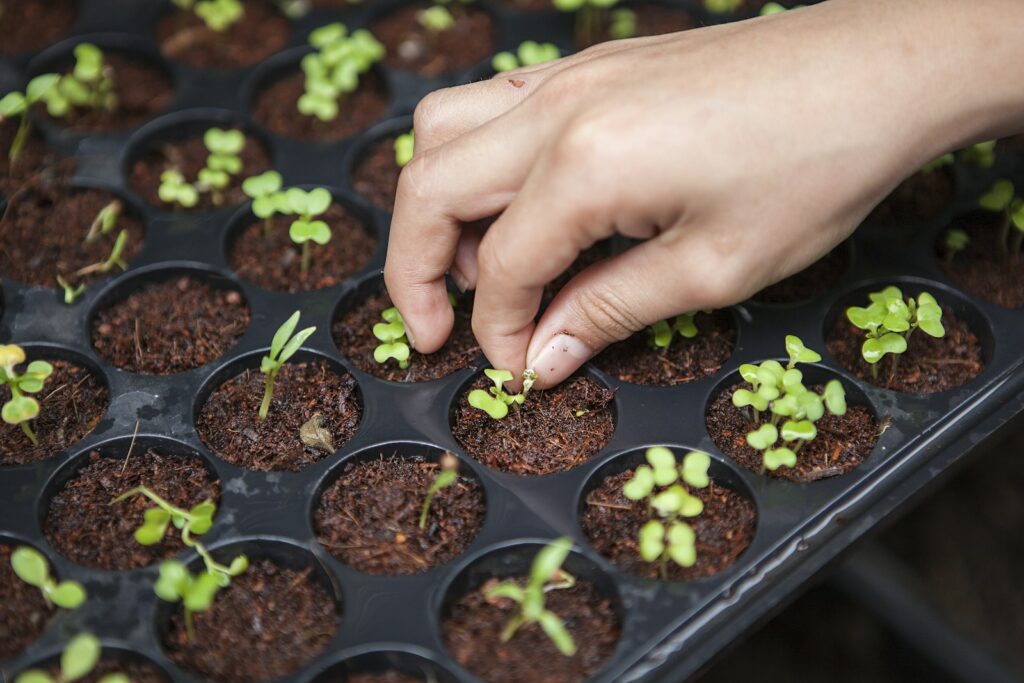
Seed is small, but sowing decides the stand you will manage all season. Sow at the depth the crop needs — a useful rule of thumb is about twice the seed’s diameter unless the packet says otherwise — into moist, fine, level soil or a clean seed compost. Keep the seedbed evenly moist until germination, and thin crowded seedlings early and ruthlessly: overcrowded plants compete, stretch, and invite disease. For transplants, harden plants off gradually if they were raised under cover, handle them by a leaf or the root ball rather than the stem, and plant at the same depth they were growing, firming gently and watering in well. Transplant late in the day or on a cloudy day where you can, to cut transplant shock. Label every bed or tray with crop, variety, and date — memory is not a record, and those dates drive every later decision about feeding, protection, and harvest timing.
3. Water and feed to need, not to habit
Water deeply and less often rather than little and often, so roots grow down instead of staying at the surface. Water early in the day where possible, direct it to the root zone rather than wetting foliage unnecessarily, and check soil moisture with a finger or a trowel before reaching for the hose — the surface can look dry while the root zone is still moist, and the reverse after a light shower. Mulch bare soil around established plants with organic material to hold moisture, suppress weeds, and protect soil structure, keeping mulch a short distance from stems. Feed based on soil test results, crop stage, and what you removed at the last harvest, not on a fixed bag routine. Leafy crops, fruiting crops, and root crops do not want the same balance at the same time, and excess feed is wasted money that can harm water and push soft, pest-prone growth. Keep a simple weekly check: are plants growing steadily, are leaves a healthy colour for the variety, and is the root zone moist but not waterlogged? Those three observations catch most water and feed errors early.
4. Prune, train, and support with a purpose
Pruning is not tidying for its own sake — every cut should have a reason: remove dead, damaged, or diseased growth, open the centre for light and air, direct energy into fruiting wood or strong structure, or keep a plant to its support and space. Use clean, sharp tools, cut at the right point for the plant, and remove diseased material from the site rather than composting it in place. Train climbing and sprawling crops onto supports early, while stems are flexible, and tie in little and often rather than forcing older growth. Support tall or heavily cropping plants before they need it — a staked, well-spaced crop is easier to spray, inspect, and harvest, and loses less to wind and ground rot. Weed while weeds are small and before they set seed, and hoe or mulch on a dry day so uprooted weeds die instead of re-rooting.
5. Protect the crop before pests and diseases take hold
The core skill is observation: walk the crop regularly, look under leaves and at growing tips, and learn what healthy growth looks like for each crop so change stands out. Identify a problem correctly before treating it — nutrient deficiency, water stress, pests, and disease can look similar at a glance, and the wrong treatment wastes money and time. Start with prevention and the least disruptive controls: rotation, resistant varieties where available, good spacing and airflow, removing badly affected material, encouraging beneficial insects, and barriers or traps where they fit the crop. Use chemical control only when monitoring shows it is justified, choose the approved product for that crop and problem, follow the label exactly, and record what you used, where, and when. That record protects you, the buyer, and the next crop in the rotation.
6. Harvest at the right moment — and keep records
Harvest quality is decided in minutes. Pick at the stage the market or kitchen needs — many vegetables are best young and tender, fruit is often picked just before full ripeness if it must travel — and harvest in the cool of the day where you can. Handle produce gently, keep it shaded and clean, and cool it promptly where facilities allow; rough handling and heat undo a season of good growing in an afternoon. Then close the loop with records: sowing and harvest dates, varieties, inputs, problems, and yields by bed or block. One season of honest notes is worth more than a shelf of general advice, because it is about your soil, your weather, and your crops. Those records are also how a hobby grower becomes a reliable commercial grower — buyers and employers trust people who can show what they did and what it produced. Those skills can be built systematically. Agritech Institute offers 100% online, self-paced study across 184 courses and five Academies, described on the site as CPD certified and internationally recognised, including horticulture, soil health, hydroponics, and agribusiness topics. Browse the full course list at https://agritech.institute/courses/ , explore the Academies at https://agritech.institute/academies/ , and see how enrolment works at https://agritech.institute/student-enrollment/ .
Frequently asked questions
Q: What are the most important horticulture skills for a beginner? A: Start with soil preparation and testing, correct sowing and transplanting, watering to need rather than habit, regular crop observation, and simple record keeping. Those five skills prevent most common failures; pruning, feeding programmes, and pest management build on them with experience.
Q: How do I know if I am over-watering or under-watering? A: Check the root zone, not the surface. Dig or push a finger several centimetres down: soil should be moist but not sodden. Wilting in midday heat alone is not proof of thirst — check again in the evening — while constantly wet soil, yellowing lower leaves, and poor growth usually point to too much water or poor drainage.
Q: Can horticulture skills lead to a job or a business? A: Yes. The same core skills are used by market gardeners, nursery and greenhouse workers, landscapers, farm teams, and growers running their own small enterprises. Demonstrable skills plus records of what you have grown are strong evidence for an employer or a customer.
Q: Can I learn horticulture online? A: Yes. Agritech Institute’s courses are 100% online and self-paced across 184 courses and five Academies, described on the site as CPD certified and internationally recognised, including horticulture topics. Start with the course list and the Academies pages linked above.
Closing — Good growing is a skill, not a gift
Nobody is born knowing how to read soil, judge moisture, or time a harvest. Growers who look gifted have usually just practised the core skills in the right order, observed closely, and kept notes season after season. You can do the same — starting with the next bed you prepare. If you want to build those skills in depth, explore Agritech Institute’s online, self-paced courses in horticulture and related topics at https://agritech.institute/courses/ , https://agritech.institute/academies/ , and https://agritech.institute/student-enrollment/ .